
Getting your measurements right before ordering flooring is one of those steps that can either make your project smooth or turn it into a headache. A lot of people rush this part and end up either short on material or stuck with extra boxes they do not need. If you take a little extra time here, you will save money, avoid delays, and make installation much easier.
Why accurate measurement really matters
When you measure your space properly, everything else becomes easier. You know exactly how much flooring to order, you avoid unnecessary costs, and your installer can work without interruptions. Even a small mistake can lead to visible gaps, mismatched sections, or waiting days for extra material to arrive.
Tools you should have before starting
You do not need anything complicated, but having the right tools helps a lot. A good tape measure is essential. If you have access to a laser measurer, it makes things faster and more accurate, especially in larger rooms. Keep a notebook or paper with you so you can write everything down immediately. A pencil and a simple calculator will also make your job easier.
Start with the basic room measurement
Begin with the main part of your room. Measure the length of the longest wall, then measure the width of the adjoining wall. Multiply these two numbers to get your square footage.
For example, if your room is 12 feet long and 10 feet wide, the total area will be 120 square feet. Always double check your measurements before moving on. It is very common to misread numbers when you are measuring quickly.
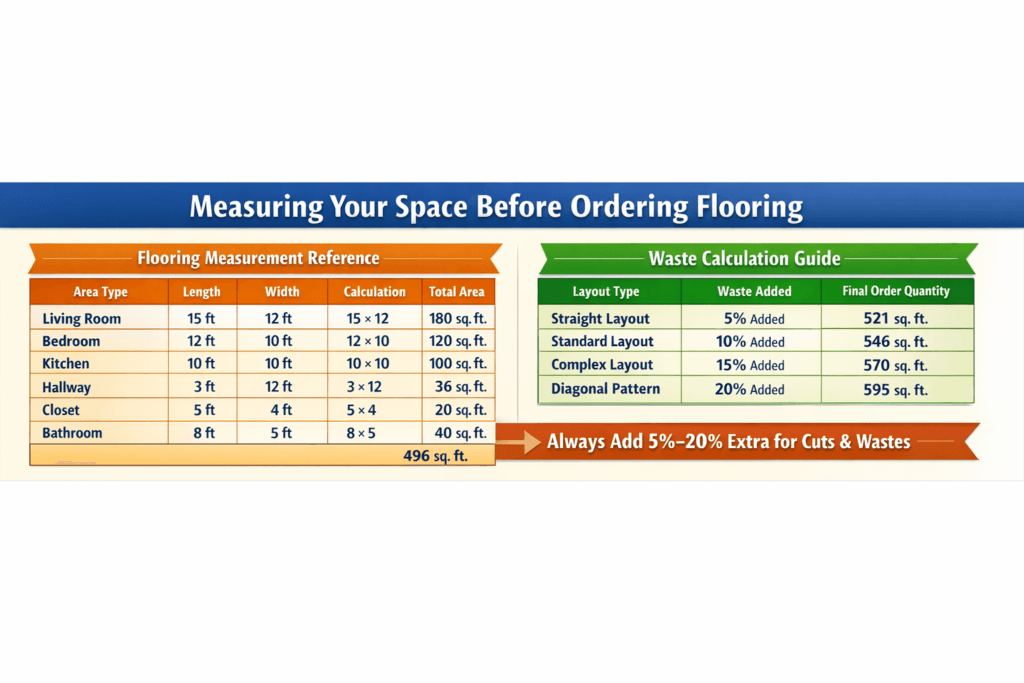
Flooring Measurement Reference Table
| Area Type | Length (ft) | Width (ft) | Calculation | Total (sq. ft.) |
|---|---|---|---|---|
| Living Room | 15 | 12 | 15 × 12 | 180 |
| Bedroom | 12 | 10 | 12 × 10 | 120 |
| Kitchen | 10 | 10 | 10 × 10 | 100 |
| Hallway | 3 | 12 | 3 × 12 | 36 |
| Closet | 5 | 4 | 5 × 4 | 20 |
| Bathroom | 8 | 5 | 8 × 5 | 40 |
| Total Area | — | — | Sum of all areas | 496 sq. ft. |
How to measure rooms that are not perfect squares
Most homes are not perfectly shaped, and that is completely normal. If your room has corners, extensions, or an L shape, the best way to handle it is to break the space into smaller sections.
Think of each section as a rectangle. Measure each one separately and calculate its area. Once you have all the individual areas, add them together to get the total. This method keeps things simple and avoids confusion.
Do not forget hallways and connecting spaces
Hallways are often missed, especially when they are narrow. Even though they look small, they can add a decent amount to your total flooring requirement.
Measure the length and width just like any other space. Multiply them and add the result to your overall total.
Include closets and small areas
Closets, storage spaces, and small corners are easy to ignore, but they matter. If you skip them, you might end up short on material.
Take a few extra minutes to measure these areas separately. Add them to your total so you have a complete and accurate number.
What about cabinets and fixed furniture
Many people ask whether they should subtract areas under cabinets or built in furniture. In most cases, it is better not to subtract these spaces.
Keeping those areas in your calculation gives you extra material for adjustments, mistakes, or future repairs. It also keeps your flooring consistent if you ever decide to change your layout later.
Calculating your total square footage
Once you have measured every part of your space, add all the numbers together. This final number is your total square footage.
For example, if your living room is 180 square feet, your kitchen is 100 square feet, your hallway is 36 square feet, and your closet is 20 square feet, your total will be 336 square feet.
Waste Calculation Table
| Layout Type | Waste Percentage | Example Total (496 sq. ft.) | Final Order Quantity |
|---|---|---|---|
| Straight Layout | 5% | 496 × 1.05 | 521 sq. ft. |
| Standard Layout | 10% | 496 × 1.10 | 546 sq. ft. |
| Complex Layout | 15% | 496 × 1.15 | 570 sq. ft. |
| Diagonal Pattern | 20% | 496 × 1.20 | 595 sq. ft. |
Always add extra for waste
This is one step you should never skip. Flooring installation always involves cutting pieces, adjusting edges, and sometimes dealing with damaged boards.
For a simple layout, adding 5 to 10 percent extra is usually enough. If your room has a more complex design or diagonal patterns, you might need 10 to 20 percent extra.
So if your total is 336 square feet, adding 10 percent means you should order around 370 square feet. It is always safer to round up rather than risk running out.
Helpful tips to get accurate results
Take your time and measure carefully. Measure each wall more than once to be sure. Write everything down clearly so you do not mix up numbers later. Try to keep all your measurements in the same unit, preferably feet.
Drawing a simple sketch of your room can also help you stay organized. Label each section so you know exactly what you have measured.
Common mistakes people make
A lot of mistakes happen simply because people rush. Skipping small areas like closets is very common. Another mistake is not adding extra material for waste. Some people also mix units or guess measurements instead of checking properly.
Avoiding these small errors can save you from bigger problems later.
When it makes sense to call a professional
If your space is large or has a complicated layout, it might be worth getting a professional to measure it for you. This is especially important if you are investing in expensive flooring. Professionals use precise tools and can ensure everything is calculated correctly.
If you are planning new flooring, LFC Texas can help you every step of the way from accurate measurements to expert installation. Their team ensures you order the right amount of material and get a clean professional finish. Visit lfctexas.co to explore flooring options and get started today.
Final thoughts
Measuring your space properly is the first and most important step in your flooring project. It might seem simple, but it has a huge impact on the final result. If you stay patient, double check your work, and include every part of your space, you will avoid most of the common problems people face.