 Skip to content
Engineered hardwood and solid hardwood are the two most popular options of wood flooring when it comes to choosing the flooring to install in your home. They both provide the classical beauty of natural wood and may contribute to the looks and value of a house greatly. Nevertheless, these types of flooring have some variations in terms of construction, life span, installation process, and the way they would work in various settings.
Homeowners find it difficult to decide on whether to go with the two since both possess distinct advantages. The correct selection can depend on factors, including the humidity levels, the location where the installation is to take place, maintenance requirements and the durability of the installation. Knowing the difference between engineered and solid hardwood will allow you to choose the flooring material that will fit your lifestyle and residential setting.
What Is Solid Hardwood Flooring?
Solid hardwood flooring consists of one piece of natural wood which is planked. Each board is cut out of hard wood which includes oak, maple, hickory or walnut. Solid hardwood flooring can also be used as it looks very natural and traditional because it is entirely made of natural wood.
Solid hardwood is a material that has been in use in the homes over the decades and has demonstrated strength, durability, and classic appeal. The old fashioned houses still have their hardwood floors and this in itself shows the duration of life of this type of flooring when well taken care of.
The most important characteristics of Solid Hardwood
- Made from 100% natural hardwood
- Typically 3/4 inch thick
- Can be refinished and sanded several times.
- Famous in long life and durability.
- Gives it an old fashioned and traditional wood look.
- The benefits of Solid Hardwood.
Long Lifespan
Hardwood floors which are solid can last several decades. Scratches and wear could be repaired since they could be refinished several times.
Natural Beauty
Each plank is treated differently in terms of the grain and color variation giving it a distinct and natural appearance.
Increases Property Value
Authentic hardwood floors in a house can make it more appealing to a buyer, and this can enhance the resale value of the house.
Disadvantages of Solid Hardwood
Solid hardwood has its weaknesses though it has its benefits.
- It is able to enlarge and shrink depending on humidity.
- Should not be used in basements or areas that are prone to moisture.
- It is normally nailed or stapled onto a subfloor.
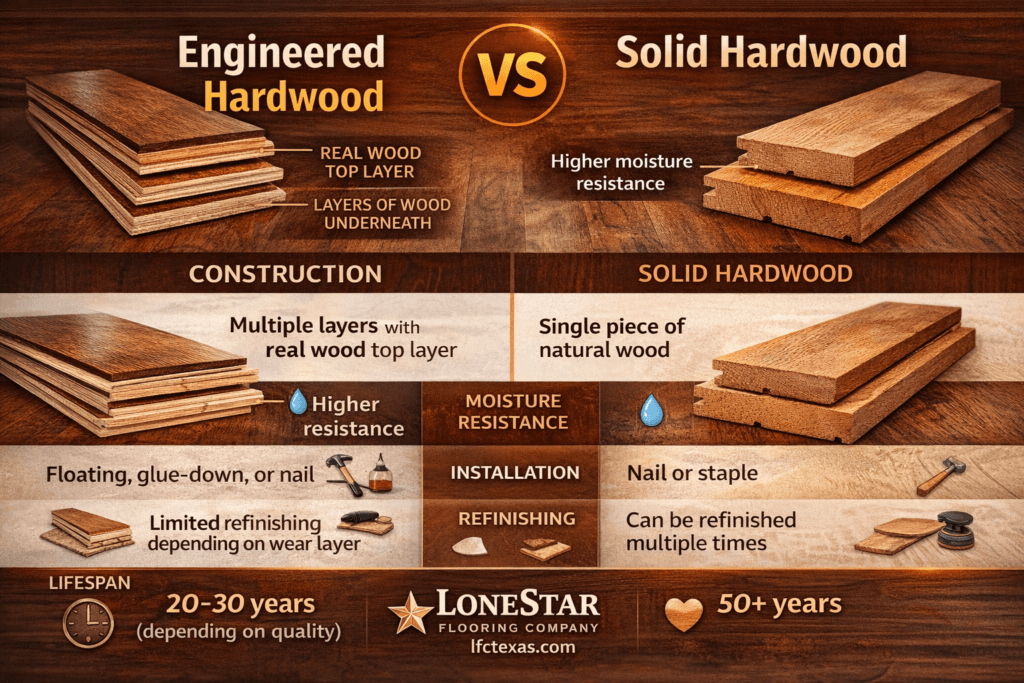
What Will Engineered Hardwood Flooring Be?
The hardwood flooring is engineered using a combination of a number of layers of wood. The upper surface is of actual hardwood, the bottom layers being of plywood or high density fiberboard.
This is the layer construction which makes engineered hardwood more stable and resistant to changes in the environment. The design contributes towards minimizing the expansion and contraction that is caused by changes in temperature and humidity of natural wood.
The salient Characteristics of Engineered Hardwood
- Real hardwood surface layer
- Several layers of structure beneath.
- Better stability of dimensions.
- Appropriate to various installation procedures.
Benefits of Engineered Hardwood
Increased Moisture Resistance
The stranded structure is useful in making engineered hardwood resistant to humidity warping and expansion.
Elastic installation procedures
It is also adaptable to all kinds of spaces as it can be installed with either the floating, glue-down, or nail-down method.
Suitable for More Areas
Engineered hardwood can be laid in the areas where strong hardwood is not advisable such as basements or higher humidity areas.
Selecting the right flooring material is an important step in any renovation or new construction project. Working with experienced flooring professionals can help ensure you choose the best materials for your space. Explore a wide range of flooring solutions and expert guidance by visiting lfctexas to discover high-quality flooring options designed for modern homes.
Key Differences Between Engineered Hardwood and Solid Hardwood
| Feature | Solid Hardwood | Engineered Hardwood |
|---|---|---|
| Construction | Single piece of natural wood | Multiple layered construction |
| Moisture Resistance | Lower | Higher |
| Installation Methods | Nail or staple | Floating, glue, or nail |
| Refinishing Potential | Multiple times | Limited depending on wear layer |
| Stability | Sensitive to humidity | More stable |
| Suitable Areas | Living rooms, bedrooms | Basements, kitchens, condos |
Durability Comparison
The two types of floorings are strong, although their performance is determined by the environment where they are laid.
Long-term strength of solid hardwood is very high since it can be refinished a number of times. This gives the homeowners an opportunity to repair the floor despite years of usage.
On the other hand, engineered hardwood works the best in areas where the humidity varies. Its stratified form is more stable, which minimizes chances of bending or cracks.
Appearance Comparison
As far as aesthetics are concerned, the two types of floorings are quite similar since the engineered hardwood utilizes authentic wood on the top. With the use of modern manufacturing methods, engineered hardwood can be used to replicate the look of traditional hardwood almost perfectly.
There will be no visual difference between the two when installed to most of the homeowners.
Cost Comparison
The price of hardwood flooring is determined by a number of factors including the wood species, its thickness, and the installation needs.
In general:
Hardwood flooring is also more expensive to install and construct in solid form.
Engineered wooden floors are generally cheaper and simpler to set.
Nonetheless, solid hardwood can be of better long-term value as it can be refinished several times.
Where Every Flooring Type Performs.
Solid Hardwood Is Ideal For
- Living rooms
- Bedrooms
- Dining rooms
- Long-term residential homes
These regions are usually characterized by high and constant level of humidity and reduced exposure to moisture.
Engineered Hardwood Is Perfect in
- Basements
- Kitchens
- Apartments or condominiums
- Regions where the humidity is variable.
It is more compatible with the environmental conditions, which is made more flexible by its construction.
How to choose right flooring
The decision between engineered wood and solid hardwood is based on a number of aspects.
Climate Conditions
Engineered hardwood is also more stable, which is why it is an advantage in homes situated in a humid environment.
Installation Area
Strong hardwood is suitable in above grade applications whereas engineered hardwood is applicable in basements and areas that are exposed to moisture.
Budget Considerations
Hardwoods Engineered hardwood tends to be cheaper to install.
Longevity Goals
Solid hardwood can be a preference in case long-term durability and refinishing possible are considered.
Final Thoughts
Both engineered and hardwood flooring provide the homeowners with the natural beauty and the warmth that they seek in wood flooring. The correct decision will be based on the environment and location of installation in the home, and long term maintenance prospects.
Solid hardwood is an old-fashioned flooring material with superior longevity and engineered hardwood gives flexibility and stability to the present day homes. Homeowners will be able to pick the flooring that is durable, stylish, and practical when they know the advantages of every alternative.
