Laying flooring is an expensive affair. Purchasing hardwood, vinyl, laminate, tile, or engineered flooring, the way you maintain them during the first one year usually helps them perform in the next ten or twenty.
The point is that you do not have to spend a lot of money on the products and follow complex regimes in order to protect your floors. The most important thing is regular Floor care and selecting the appropriate cleaning process on your surface, and damage prevention before occurring.
This guide describes specifically how to suggest your new floors to be maintained and taken care of so that they remain beautiful and strong over the years.
Begin with the daily habits that are right
The majority of the damage caused to the floorings is a result of minor, repetitive activities. Dust, sand and small rocks serve as sand papers on shoes.
Easy things that save your floors:
- Install doormats on all entries.
- Remove shoes when possible
- Sweep or vacuum high-traffic locations on a daily basis.
- Wipe up spills immediately
These traditions form the basis of good Floor care and prevents scratches on the surface, moisture damage, and dull finish.
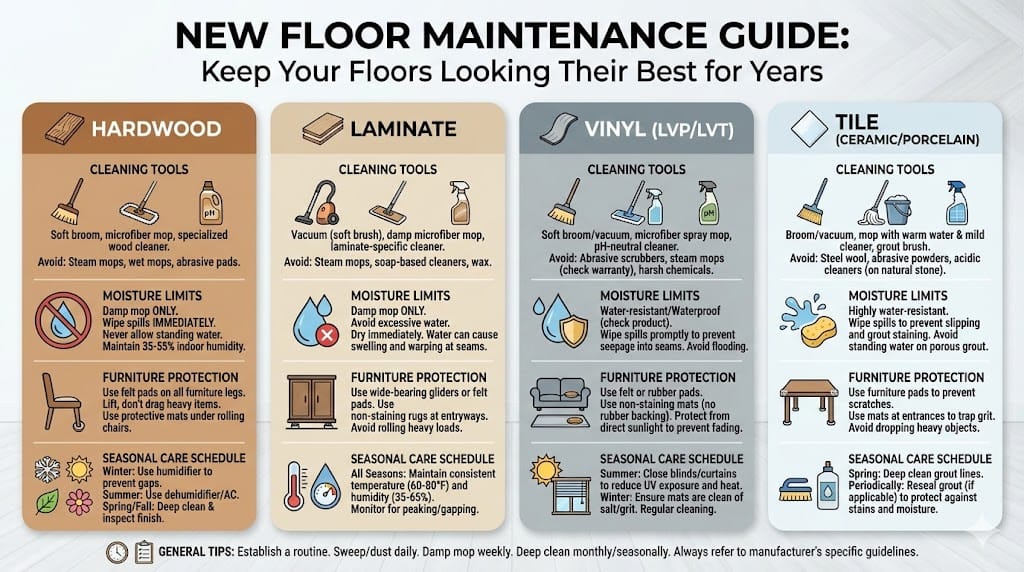
Understand your floor type before cleaning
Different materials react very differently to water, chemicals, and tools. Using the wrong product is one of the fastest ways to shorten a floor’s life.
Here is a quick comparison to help you choose the right approach.
| Flooring type | Safe cleaning method | What to avoid | Main risk |
| Hardwood | Damp microfiber mop, pH-neutral cleaner | Steam mops, soaking water | Warping, finish damage |
| Laminate | Lightly damp mop, dry vacuum | Excess moisture | Swelling, edge lifting |
| Vinyl / LVP | Mild cleaner, soft mop | Abrasive pads, wax | Dull surface |
| Tile | Neutral cleaner, grout-safe brush | Acidic cleaners | Grout erosion |
| Engineered wood | Light moisture, soft cloth | Standing water | Layer separation |
Knowing your material is essential for long-term Floor care and helps avoid expensive repair mistakes.
Clean smarter, not harder
Excessive house-cleaning is as injudicious as laxity. A lot of people who own houses scrub strongly, or apply harsh chemicals in the belief that it will prolong the life of the floors. The truth about the matter is that soft cleaning helps to preserve protective coatings, and also maintain the surface.
A less hazardous routine would have the following appearance:
- Dry sweep or vacuum first
- Wipe it with a slightly moist mop and not a wet one.
- Clean in small sections
- Wipe off surface in case of moisture.
Such a managed strategy minimizes residual accumulation and promotes the uniformity of Floor care in each room.
Protect high-traffic areas
The bedrooms and guest rooms have longer lives compared to the entryways, kitchens, hallways, and living rooms. The trick is to avoid friction and impact in these areas.
Practical protection tips:
- Install carpet flooring by door and sink.
- Have felt pads under the chairs and furniture.
- Change worn out furniture slips frequently.
- Turn carpets after every few months so as to equalize the wear.
These measures can be dramatically used to reduce the wear of the surface and help provide more effective Floor care of the whole house.
Restrain dampness and indoors humidity
One of the largest foes of flooring is moisture. Water-resistant materials, even cannot be damaged in the long term in case of excessive humidity.
Recommended actions:
- Maintain indoor humidity of 35 to 55%.
- Install exhaust fans in kitchens and bath rooms.
- Repair leaks in the pipes.
- Wipe off wet shoes, umbrellas, paw of pets and walk in.
One of these components of correct Floor care is moisture control, which helps avoid cupping, swelling, and mold growth, and adhesive failure.
Safety use furniture on new floors
During move-ins, renovations and furniture rearrangement, new floors are frequently damaged.
Always remember:
- Move the furniture not drag it.
- Heavy furniture should be moved with furniture sliders.
- Floor protection when installing appliances.
- Do not put sharp metal legs on the surface.
These are basic measures that can avoid deep gouging that is hard and very expensive to fix in the future.
Use seasonal maintenance schedule
The floors are sensitive to temperature and humidity. A seasonal routine would prevent material stress which is caused by long term.
Spring and summer
- Enhance the frequencies of increase.
- Watch for humidity buildup
- Check doors and windows with regard to moisture.
Fall and winter
- Just clean salt and grit.
- Take soft mats to pick up rubbish.
- Check the indoor air dryness of wood floors.
This season program will enhance your general strategy of Floor care and prevent minor problems to develop into permanent harm.
What should be maintained professionally
Professionals need to perform some types of maintenance work with regard to premium or natural materials.
Professional service is required when:
- The hardwood finish seems scratched or foggy.
- Several boards are affected by deep scratches.
- Grout on tile is very stained or fissured.
- Floors start growing upward or drifting apart.
Professional care will upgrade your flooring several years and will restore its initial appearance.
Reliable Solutions for Texans by LFC Texas
When Texans need dependable, high‑quality services they can trust, LFC Texas delivers professional solutions with a focus on customer satisfaction and long‑lasting results. From expert support to tailored offerings designed to meet your unique needs, LFC Texas combines experience and commitment to help you get the best outcomes possible. Whether you’re researching services or ready to take the next step, learn more about how LFC Texas can support your goals by visiting LFCTexas.com — your resource for trusted expertise and exceptional service throughout Texas.
Errors reducing the lifespan of new floors
It is important not to make the wrong habits as well as to make the right ones.
Common mistakes include:
- Steaming wood or laminate
- with steam mops.
- Improving vinyl or laminate with wax.
- Ignoring water spills
- Using abrasive scrubbers
- Avoiding use of protective pads beneath furniture.
By averting such flaws, your floors will continue working as desired in a long time even after installation.
Quick maintenance checklist
| Task | Frequency | Why it matters |
| Sweep or vacuum | Daily in busy areas | Prevents surface scratching |
| Damp mop | Weekly | Removes residue safely |
| Inspect furniture pads | Monthly | Stops hidden scuffing |
| Check humidity levels | Monthly | Prevents expansion and warping |
| Deep professional cleaning | 12–24 months | Restores appearance and protection |
Final Thought
When taken care of, new floors can last decades with ease. Habits every day, control of moisture, right cleaning equipment, and early identification of the problem are the most significant issues. With the creation of an attainable schedule and the use of routine Floor maintenance, you save your investment, even maintain an aesthetic look and save on expenses related to repairs in the long run. When performed on small scale, today it will make your floors look new many years onwards.