Home is also humid and therefore you might have a silent killer walking around your home. Moisture is one of the largest enemies of long lasting floors, and swollen planks are just the beginning of such enslavement, disguised mold being the most common during warm coastal stormy areas.
The selecting of humidity-resistant flooring will not be only a matter of appearance in case you have a place of residence where the humidity is high. It is one thing that is concerned with safeguarding your investment, enhancing IAQ and ensuring that your home is comfortable throughout the year.
This guide outlines the types of flooring that really work well in a home with high levels of humidity and which ones they should avoid.
The importance of humidity to your floors
High indoor humidity causes:
- Expansion and contraction
- Weak adhesive bonds
- Hispanic Growth beneath flooring.
- Musty odors and staining
Poorly ventilated homes, slab foundations or older subfloors, make especially vulnerable homes. This is why the owners of houses nowadays actively look after the humidity-resistant flooring which can make it through long summers and high amount of moisture without being constantly fixed.
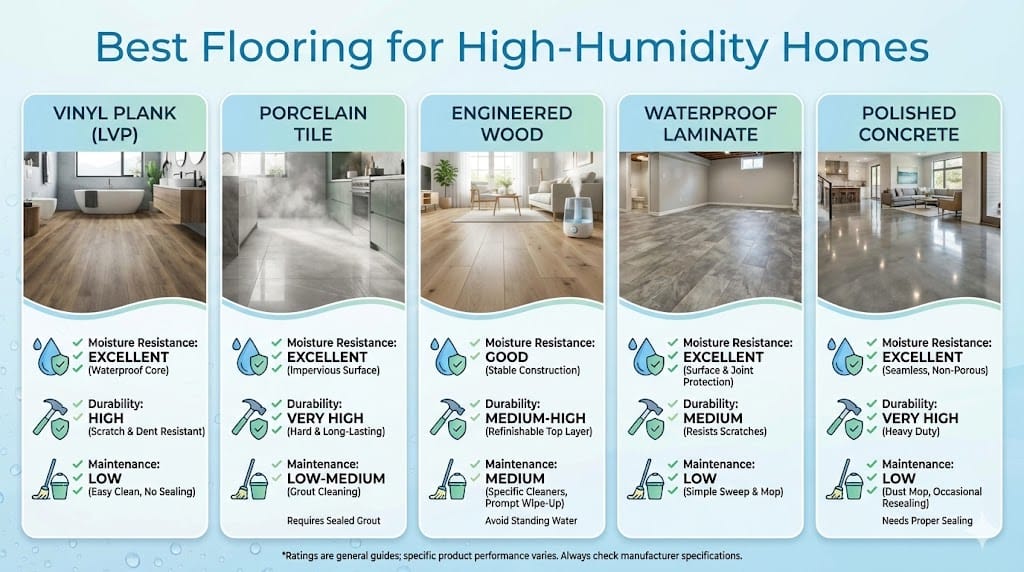
Luxury vinyl plank (LVP)
Luxury vinyl plank is relatively one of the safest also in humid climates.
Why it works well
- 100% water-resistant core
- Constant in temperature fluctuations.
- Easy floating installation
- Soft underfoot and quiet
Hardwood and stone are also well mimicked with regard to modern LVP designs. This performs well and is stylish to the busy families and those who have pets or kitchens. LVP is the first choice that is being offered by many installers, in case clients want their floors to be humidity-resistant throughout the house.
Porcelain and ceramic tile
And tile has always been reputed to be used where there is humidity–reasonably so.
Key advantages
- Non-porous surface
- Outstanding moisture and spillage resistance.
- Prolonged operation and low maintenance.
- Radiant heating – Works well with radiators.
Specifically, porcelain tile retains a minimal amount of water and does exceptionally well in the kitchen, the bathroom, and the entrance. To the homeowners, who intend to enjoy the maximum durability, the tile is still a high-end choice of humidity resistant flooring.
Engineered wood
Normal hardwood solid does not perform well in damp houses. Engineered hardwood is however constructed differently.
The reason how engineered is superior.
- Plywood with multi-layers core enhances stability.
- Reduced movement in comparison with solid wood.
- May be applied to concrete slabs.
It still requires due humidity care but it is a viable option to home owners that desire a natural look of wood but reduce chances of moisture attack. It can be used as a living space controlled-environment humidity-proofed flooring when it is installed with vapor barriers.
Laminate flooring with water-proof effects
New laminate has become far more refined as compared to a few years.
What is new laminate superior to?
- Sealed edges
- Waterproof surface finishes.
- Antifractionated wearing surfaces.
One should use the laminate that has been marked or identified as waterproof or water-resistant. Ordinary laminate is easily swellable. Mufti proof laminate provides cost effective humidity proof flooring to the bedrooms and living room.
Polished concrete
In the wet areas, concrete floors are becoming popular.
Benefits include
- No organic material to rot
- Very low maintenance
- Fits well with contemporary interiors.
- Superior thermal performance.
When sealed well, polished concrete does not allow entry of moisture nor stains on the surface. It is among the long-term solutions, which are the most lasting, among the homeowners who really require flooring, which is humidity-proof, in the entire house.
The types of floors that you should not have in wet houses
Certain materials are just not accommodating to moisture:
Solid hardwood flooring
Flooring Cork flooring, not waterproofed.
Natural bamboo in cores that are not strand-woven.
Ericle carpet flooring with moisture taking carpets.
These materials absorb water, retain it and raise the possibility of mold and bending.
Quick comparison table
| Flooring Type | Moisture Resistance | Best Rooms | Maintenance Level |
| Luxury vinyl plank | Excellent | Whole house | Low |
| Porcelain tile | Excellent | Kitchens, baths | Low |
| Engineered hardwood | Moderate–Good | Living areas | Medium |
| Waterproof laminate | Good | Bedrooms, halls | Low |
| Polished concrete | Excellent | Whole house | Very low |
Flooring installation information which guarantees a safe investment
Even the finest flooring cannot work unless it is installed in a wrong manner.
Always ensure:
- Subfloor moisture test.
- Proper vapor barriers
- Correct expansion gaps
- The one before installation, climate-regulated acclimation.
The professional installers also suggest that you must have indoor humidity monitoring system and better ventilation system to go with your new floor.
For best flooring and cabinets contact lfctexas.
Final Thought
Selecting the appropriate flooring in a wet household is far beyond the fashionable appearance. Always come first should be moisture resistance, stability and long performance. With the materials that do not warp, mold and surface damage, homeowners can have comfortable living areas which will remain beautiful throughout the years. The safest flooring choices are geared towards prevention- and the simplest activity entails investing in the realfully humidity resistant flooring.